What to prepare for a safe check
All you need is good light, a loupe or your phone camera with zoom, a soft cloth and a strong magnet. Work over a table covered with fabric so the jewellery is not damaged further if it falls. If the piece has a loose stone, a crack or a delicate antique construction, stop handling it and have it assessed professionally right away.
1. Examine the hallmark and other marks
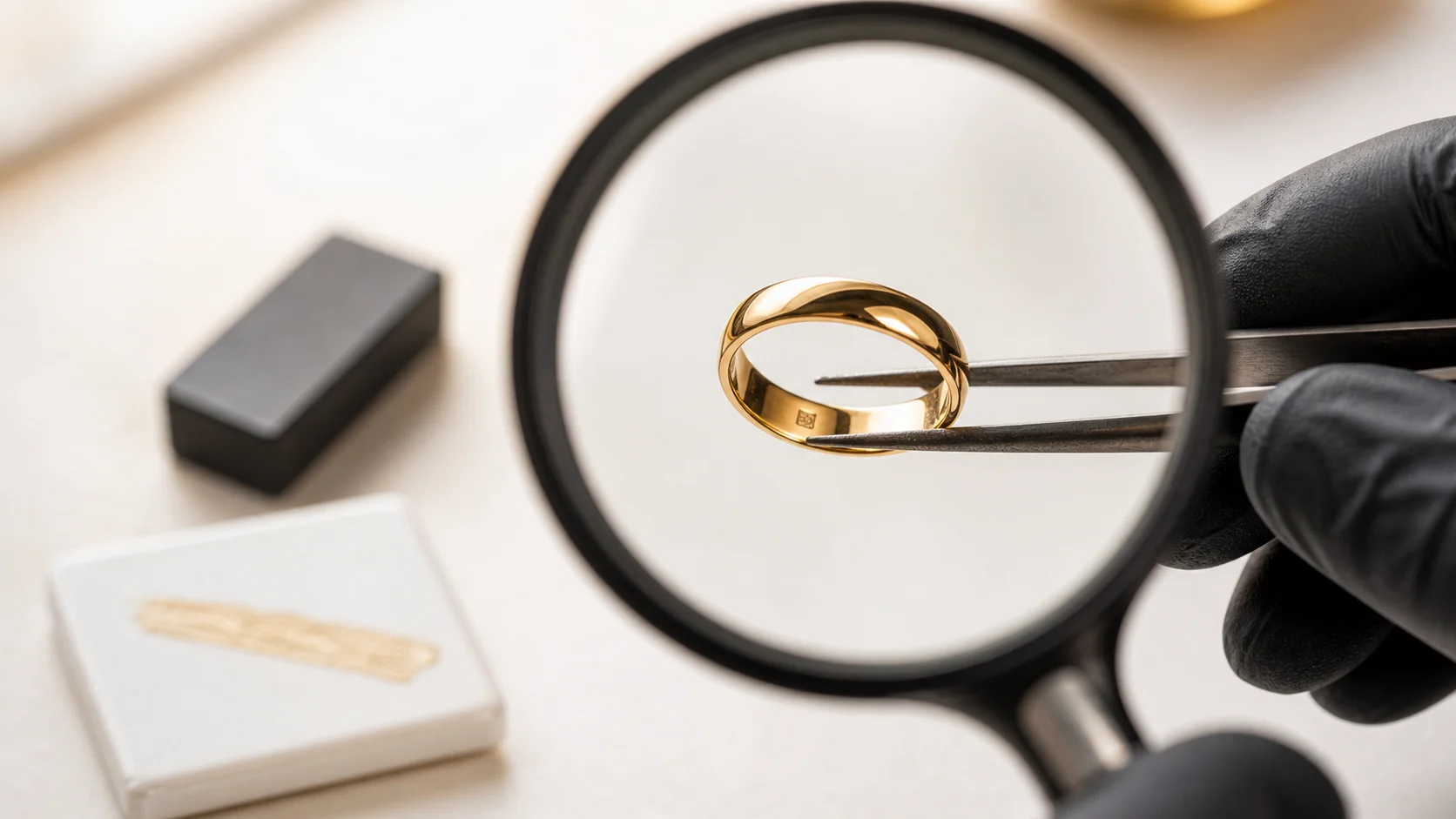
On Czech gold goods, look for the state hallmark and the fineness number, for example 585 or 750. The fineness number tells you how many thousandths of the alloy are gold: 585 means 58.5% gold, i.e. 14 carats. The number alone is not the same as the state hallmark and it can also appear on costume jewellery. Compare the shape of any mark you find with the official overview of the Czech Assay Office.
On rings the marks are usually inside the band, on chains near the clasp. Older Czechoslovak or foreign marks may look different, and a missing hallmark by itself does not mean a fake. Small, worn or repaired pieces can have a very faint mark.
2. Check the surface and the most worn spots
Inspect the edges, the inside of a ring, the links, the joints and the area around the clasp. On a gold-plated item, a different colour of the base metal may show through exactly in these places. Sharp colour transitions, flaking or spots where the golden shade disappears are suspicious.
A colour change alone is not proof, though. White gold is usually rhodium-plated and its surface can wear naturally over time. A soldered joint or a different alloy in the clasp may also have a slightly different shade.
3. Use a magnet only as an exclusion test
Gold itself is not ferromagnetic. If the whole piece is strongly attracted to a magnet, it probably contains iron or steel and is not a solid gold item. A weak response only at the clasp may come from a small steel spring inside it.
No magnetic response does not confirm authenticity. Brass, copper and many other base metals are also non-magnetic. Always judge the result together with the marks and the condition of the surface.
4. Treat weight only as a rough guide
Gold has a high density, so a compact gold item feels heavy for its size. A comparison only makes sense between pieces of similar size and construction. A hollow piece, a ring with a stone or an item made of several materials can be lighter or heavier for a completely different reason.
Home density measurement in water is suitable rather for a simple solid bar without stones and cavities. On jewellery the result can be misleading, and contact with water can damage glued stones or sensitive surface finishes.
Which home tests to avoid
- Ceramic tile and file: they leave a scratch and can reduce the value of the jewellery.
- Acids: a wrong concentration or application directly on the surface can damage the metal, the solder and the stones; professional acid testing on a touchstone requires experience and reference samples.
- Vinegar, bleach and other cleaning agents: the result is not reliable and the chemicals can alter the surface.
- Fire and heating: soldered joints, stones and surface finishes can be damaged.
- Biting the metal: it proves nothing reliably and you can damage both the jewellery and your teeth.
When to stop testing at home
As soon as the results are inconclusive, stop testing the piece. A professional check combines knowledge of hallmarks with instrument-based or expert material testing and precise weighing. For stones, hollow parts and antique pieces, the value of the metal is also assessed separately from the value of the whole item.
In our shop we will verify authenticity and purity for you during a non-binding gold valuation in Prague. If you want to understand the magnet test and the individual purities in more detail, continue with the article How to recognize real gold at home.